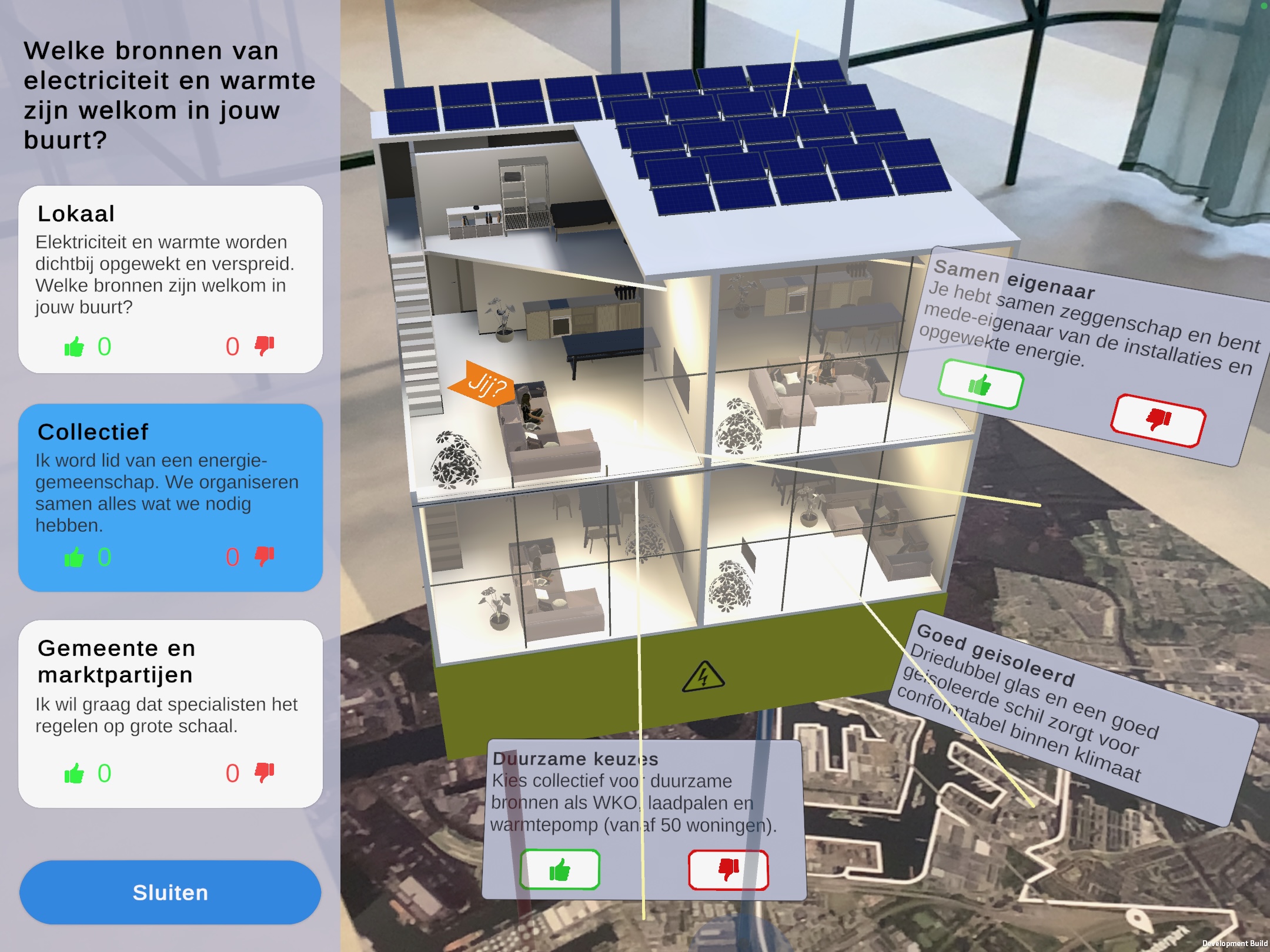
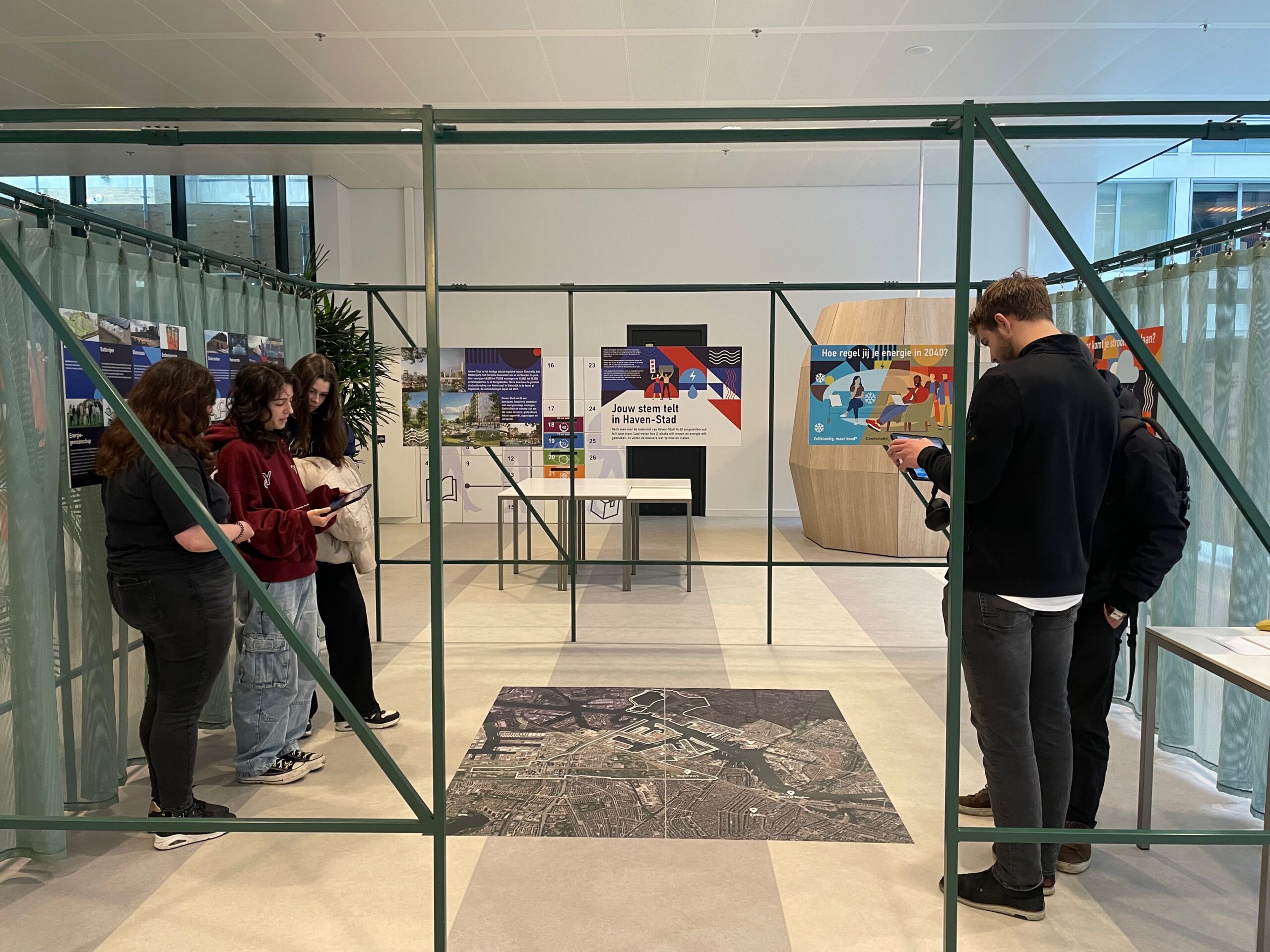
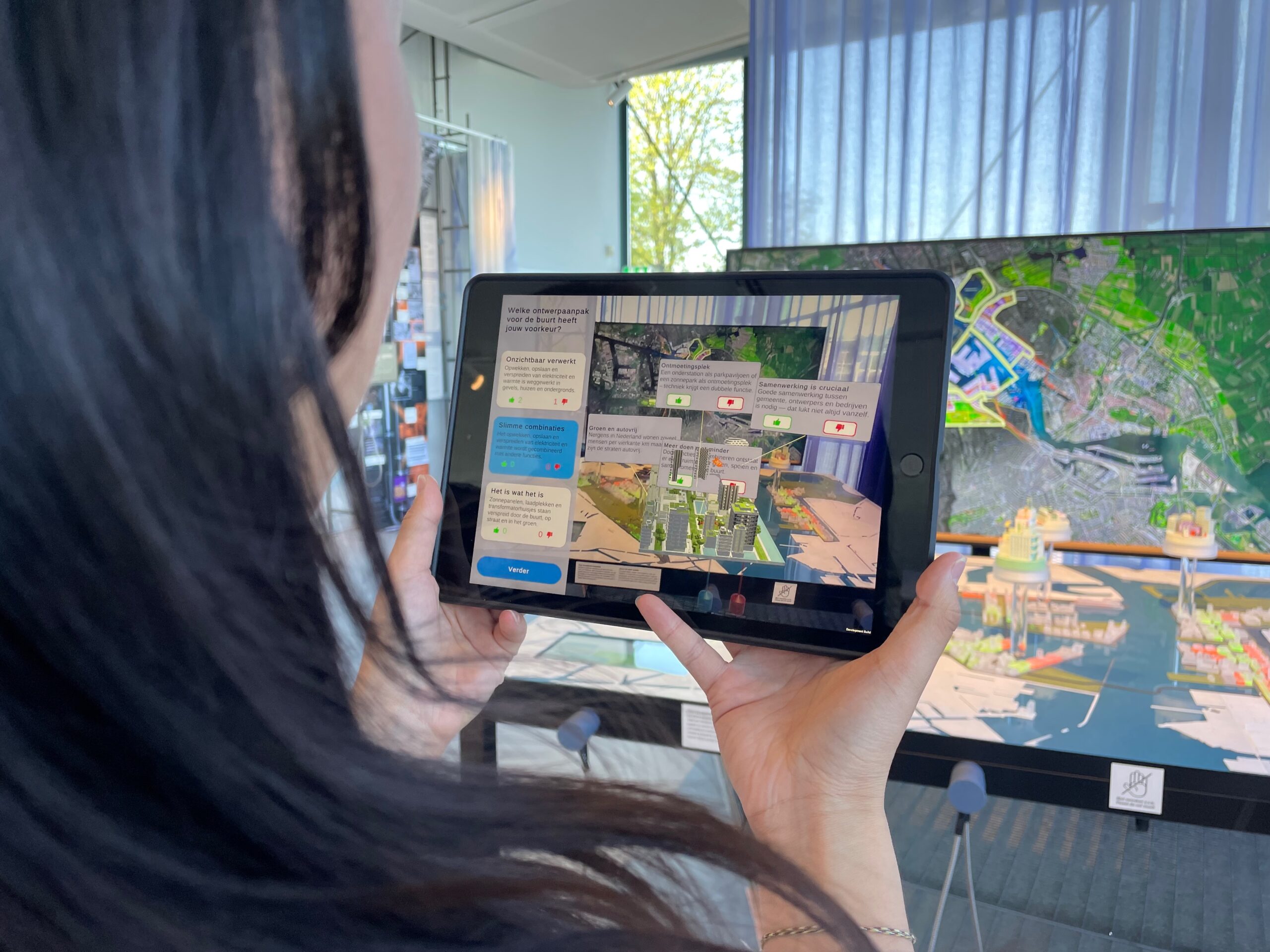
We succesfully tested another iteration of the Haven-Stad prototype with more than 100 students in the entrance hall of the Jakoba Mulderhuis on April 22-24. Developed by Studio Bertels for Transition-Scapes and the Civic Interaction Design research group, the prototype uses augmented reality to interact with the multimedia installation Model-City Haven-Stad in Arcam. It can also be used at other public locations using printed maps. Young adults are invited to join a youth council that will grow over time. Instead of being a stand-alone tool, the interactive model forms part of a series of moderated events. However, at the Jakoba Mulderhuis, students primarily used the model individually or in small groups to understand the complexities of a future energy system. They explored what it could look like and how it could be set up in Haven-Stad at three levels: home, street, and neighbourhood. They also received extra information to help them make informed decisions and refine their ideas.
After a short introduction, most students spent considerable time engaging with the tool and the subject matter. Short follow-up conversations were held to understand their choices and collect feedback, especially on how they experienced the spatial and visually realistic approach of the prototype. A preliminary look at the participants’ responses indicates that most students prefer the local government and market to manage the future energy system, rather than opting for collective or independent solutions. A detailed evaluation is forthcoming. However, the initial insights and feedback can serve as a starting point for a long-term exploration—possibly led by an urban curator—aimed at building a community around a local energy system.
You can read more about the project here.